

In the dynamic business landscape of 2026, optimizing your sales funnel is no longer a luxury; it’s a necessity. Many businesses are already seeing how AI can streamline operations, but few are mastering the art of prompt engineering. Are you leaving money on the table by not fully utilizing the power of AI to guide potential customers through each stage of your sales process?
This guide will delve into how strategic prompt engineering can transform your sales funnel. Forget generic AI-content—we’ll focus on crafting specific prompts that resonate with your audience, address their needs, and ultimately drive conversions. Get ready to unlock the secrets to a more efficient, personalized, and profitable sales journey.
Is Prompt Engineering the Missing Piece in Your Sales Puzzle?
How AI prompts are revolutionizing business funnels in 2026
The year is 2026, and AI-driven solutions are no longer futuristic concepts; they’re the norm. In sales, this translates to automated content creation, personalized customer interactions, and data-driven insights at every funnel stage. Prompt engineering—the art of crafting effective instructions for AI models—is the key to unlocking these benefits. Instead of relying on generic AI outputs, businesses are using precisely worded prompts to generate content tailored to specific audience segments and funnel stages. This results in increased engagement, higher conversion rates, and a more efficient sales process overall. It allows for dynamically adjusting messaging based on customer behavior, something that was simply too time-consuming to execute manually just a few years ago.
The cost of ignoring prompt engineering for your sales strategy
Failing to adopt prompt engineering in your sales strategy carries significant consequences. You risk relying on generic content that doesn’t resonate with your target audience, leading to lower engagement and missed sales opportunities. Competitors who leverage AI effectively will gain a distinct advantage, capturing market share and establishing stronger customer relationships. Moreover, without prompt engineering, you’ll struggle to personalize customer interactions at scale, resulting in a less satisfying customer experience and reduced loyalty. This ultimately translates to a higher cost per acquisition, lower customer lifetime value, and a stagnant or declining revenue stream. Consider it the difference between using a scalpel (prompt engineering) and a sledgehammer (generic AI content) – both can “cut,” but one is far more precise and effective.
Decoding the Sales Funnel: A Quick Refresher for Business Owners
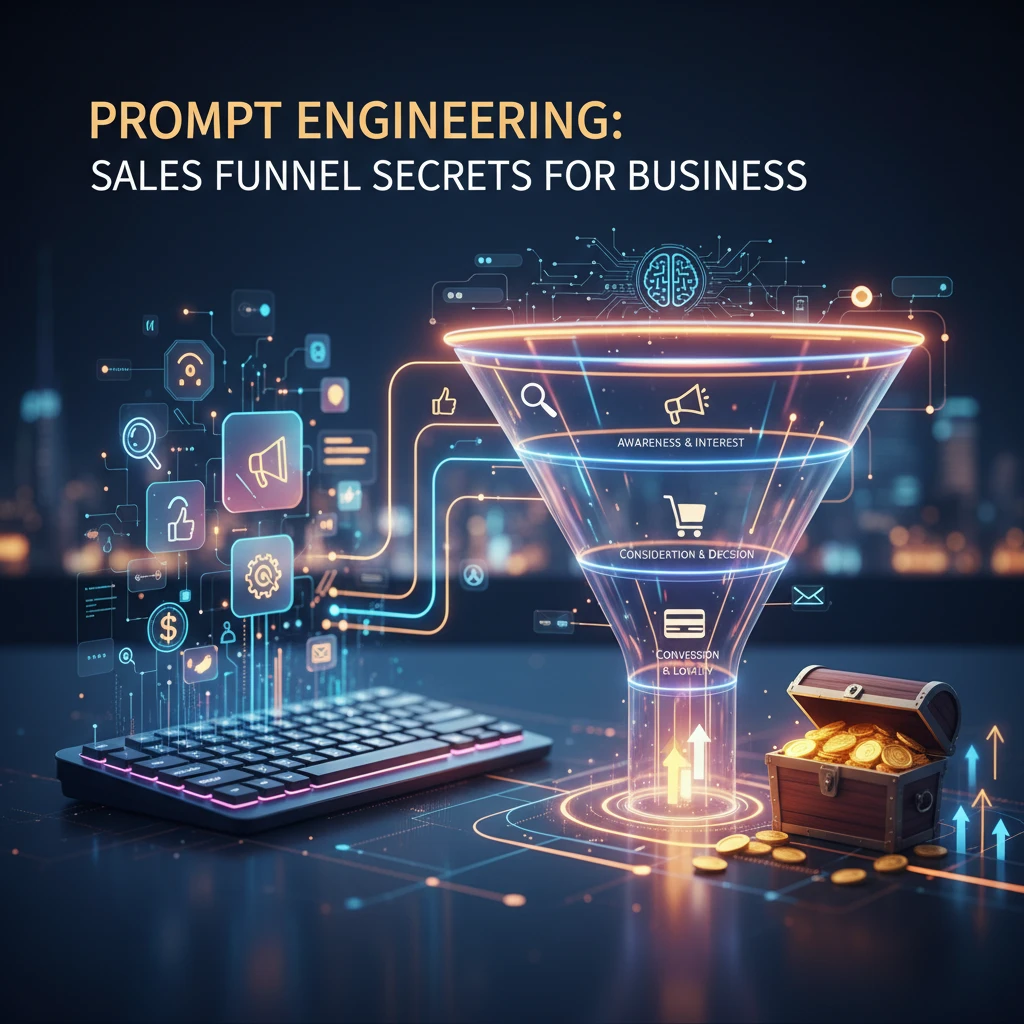
Understanding each stage: Awareness, Interest, Decision, Action
The sales funnel represents the customer’s journey from initial awareness to final purchase. It’s typically divided into four key stages: Awareness, Interest, Decision, and Action. The Awareness stage is about attracting potential customers to your brand through content marketing, social media, or advertising. The Interest stage involves nurturing those leads by providing valuable information and building trust. The Decision stage focuses on addressing objections and showcasing the unique value proposition of your product or service. Finally, the Action stage aims to convert interested prospects into paying customers, encouraging them to make a purchase or take a desired action.
Key metrics to track in your sales funnel (and why they matter)
To optimize your sales funnel, it’s crucial to track key metrics at each stage. In the Awareness stage, monitor website traffic, social media engagement, and brand mentions to gauge the reach of your marketing efforts. In the Interest stage, track lead generation rates, email open rates, and content downloads to assess the effectiveness of your lead nurturing campaigns. In the Decision stage, monitor conversion rates, sales qualified leads (SQLs), and demo requests to measure the impact of your sales messaging. In the Action stage, track customer acquisition cost (CAC), customer lifetime value (CLTV), and churn rate to evaluate the overall profitability of your sales process. Regularly analyzing these metrics will provide valuable insights into areas for improvement and help you make data-driven decisions to optimize your sales funnel’s performance.
The Prompt Engineering Advantage: Automating and Optimizing Your Sales Journey
How to use AI to generate personalized content for each funnel stage
Prompt engineering allows you to leverage AI to create personalized content at scale, tailored to each stage of the sales funnel. For example, in the Awareness stage, you can use prompts to generate attention-grabbing headlines and social media posts that resonate with your target audience. In the Interest stage, prompts can be used to create informative blog posts, engaging email sequences, and personalized case studies that address specific pain points. In the Decision stage, AI can generate persuasive sales scripts, compelling product demos, and personalized proposals that highlight the value of your offering. And in the Action stage, prompts can be used to create enticing call-to-actions, personalized onboarding materials, and exclusive offers that incentivize conversions. By using prompt engineering to create hyper-relevant content, you can dramatically improve engagement and drive conversions at every stage of the sales funnel. For further improving SEO and content, you might want to look into the details of AI-powered content for SEO.
Scaling your sales efforts with AI-powered prompts: Real-world examples
AI-powered prompts offer businesses unprecedented opportunities to scale their sales efforts. Imagine a real estate company using AI to generate personalized property descriptions based on customer preferences and search history. Or a SaaS provider using prompts to create customized onboarding tutorials for new users, reducing support requests and improving customer satisfaction. Another example: a financial services firm uses prompts to tailor investment advice based on individual risk profiles and financial goals. The possibilities are endless. By automating content creation and personalizing customer interactions, AI-powered prompts enable businesses to reach more potential customers, nurture leads more effectively, and close deals more efficiently, all while freeing up valuable time for sales and marketing teams to focus on higher-level strategic initiatives. For those looking to further amplify their reach, combining these AI strategies with a solid AI marketing automation framework is extremely powerful.
The difference between a good prompt and a *great* prompt that converts
A “good” prompt might instruct the AI to “write a blog post about [topic].” A “*great*” prompt, however, provides context, specifies the target audience, defines the desired tone, and includes specific keywords. For example, a great prompt might be: “Write a blog post targeting small business owners in the USA aged 30-45, discussing the benefits of prompt engineering for sales funnels. Use a professional but approachable tone, and include the keywords ‘AI sales funnel,’ ‘prompt engineering,’ and ‘conversion optimization.’ The post should highlight three specific examples of businesses that have successfully implemented prompt engineering strategies, with quantifiable results.” The key difference lies in the level of detail and specificity. Great prompts provide the AI with a clear understanding of the desired outcome, leading to more relevant, engaging, and ultimately, converting content. A poor prompt leads to generic content, while a well-crafted prompt ensures the AI generates output that aligns perfectly with your sales objectives.
Crafting Killer Prompts for Each Stage of the Sales Funnel
Awareness Stage: Prompts that grab attention and spark curiosity
For the Awareness stage, your prompts should focus on generating intriguing and shareable content. Example: “Create five different Twitter hooks to promote a blog post about using AI for local SEO, targeting restaurant owners. Each hook should be under 280 characters and include a relevant emoji. Focus on pain points like ‘difficulty ranking on Google Maps’ and ‘struggling to attract local customers.'” Decision criteria for a good result include high click-through rate potential, relevance to the target audience, and adherence to brand voice. A pitfall to avoid is creating overly sensationalized or clickbait-y content that could damage brand credibility. Actionable steps: Review existing top-performing content, identify common themes and pain points, and use those insights to inform your prompt creation. Test variations of prompts to see which ones yield the most compelling headlines.
Interest Stage: Prompts for building trust and establishing authority
In the Interest stage, prompts should aim to provide valuable information and demonstrate your expertise. Example: “Generate an outline for an email sequence designed to nurture leads who downloaded an ebook about ‘5 AI tools every business should use’. The sequence should consist of four emails sent over two weeks, each focusing on a different AI tool and its specific benefits. Include suggested subject lines and calls-to-action for each email.” Key decision criteria include relevance to the lead magnet content, demonstration of expertise, and a clear progression of value. A common pitfall is being overly promotional or pushy. Actionable steps: Map out the buyer’s journey, identify key questions and concerns at the Interest stage, and craft prompts that address those issues in a helpful and informative way. Consider exploring AI-driven strategies for content marketing to boost your ROI.
Decision Stage: Prompts that address objections and showcase value
Prompts in the Decision stage should directly address potential objections and highlight the unique value proposition of your product or service. Example: “Create a script for a short video testimonial featuring a hypothetical customer who overcame a specific challenge using our AI-powered SEO platform. The testimonial should be approximately 60 seconds long and focus on quantifiable results, such as ‘increased website traffic by 40%’ and ‘reduced customer acquisition cost by 25%’. Include a call to action to schedule a demo.” Decision criteria should include how convincingly the testimonial addresses common concerns and how clearly it showcases the platform’s value. The main pitfall is creating overly generic or unrealistic testimonials. Actionable steps: Gather data on common objections from sales calls and customer feedback, and use that information to craft prompts that specifically address those concerns.
Action Stage: Prompts for driving conversions and closing deals
For the Action stage, prompts should focus on creating a sense of urgency and encouraging immediate action. Example: “Generate five different versions of a limited-time offer email promoting a discount on our premium AI-powered digital marketing training package. Each email should emphasize a different benefit of the package, such as ‘increased ROI,’ ‘time savings,’ or ‘improved customer engagement,’ and include a clear call to action with a deadline.” Key decision criteria include the persuasiveness of the offer, the clarity of the call to action, and the sense of urgency created. A common pitfall is being overly aggressive or sales-y. Actionable steps: Analyze past successful promotional campaigns, identify key drivers of conversion, and use those insights to inform your prompt creation. Test different offer structures and calls to action to see which ones perform best.
Prompt Engineering Recipes: Ready-to-Use Templates for Sales Success
Effective prompt engineering doesn’t require starting from scratch every time. Creating and using templates can significantly streamline your workflow and ensure consistency in your sales efforts. Here are some prompt templates you can adapt for various sales scenarios. When creating these templates, consider defining key parameters such as the target audience, desired tone, and specific product features to be emphasized. The clearer the instructions, the better the output.
Example prompt: Generate engaging social media posts for [product/service] targeting [ideal customer]
This prompt is designed to create a series of social media posts tailored to your specific audience and product. For instance: “Generate engaging social media posts for ‘Organic Skincare Line’ targeting ‘Women aged 25-45 interested in natural beauty products.'” To improve the output, specify the platform (Facebook, Instagram, etc.) and desired tone (e.g., informative, humorous, inspirational). A pitfall to avoid is being too broad; specify the benefits of your product in detail. For example, highlight ingredients like “rosehip oil” and its benefits such as “reducing wrinkles” to get more focused results. Remember to include a call to action. For example, use phrases like, “Shop now,” or, “Learn more at our website,” to drive engagement. Furthermore, mention that you want the output to be in the tone of a beauty blogger. Finally, to avoid a generic response, specify the platform (Instagram, X, LinkedIn) and ask for content that is native to the platform.
Example prompt: Write a compelling email subject line to increase open rates by [percentage]
A catchy subject line is crucial for email marketing success. Use this prompt to brainstorm subject lines that grab attention. An example: “Write a compelling email subject line to increase open rates by 20% for a ‘Summer Sale’ email campaign.” Consider including keywords that resonate with your audience (e.g., “Exclusive,” “Limited Time,” “Free Gift”). A common mistake is to create subject lines that are clickbait and misleading. For instance, “Urgent: Your Account Needs Attention” might get opens but could damage trust if the content doesn’t match the subject. Instead, focus on creating subject lines that clearly communicate the value proposition, such as “Summer Sale: 50% Off All Dresses This Week Only”. To evaluate the prompt’s success, track your open rates with a tool such as Google Analytics. Remember to tailor the tone of the subject line to your brand. For example, a luxury brand will focus on exclusivity over urgency.
Example prompt: Create a persuasive sales script for handling common customer objections related to [specific concern]
This prompt focuses on crafting effective responses to customer objections, a critical skill for any sales team. An example might be: “Create a persuasive sales script for handling common customer objections related to the ‘high price’ of our premium software.” Start by listing the common objections your team encounters. The script should address those objections head-on with clear and concise explanations of the product’s value and benefits. Don’t just dismiss the customer’s concerns, acknowledge them and offer a solution. For instance, if a customer says, “It’s too expensive,” your script could respond with, “I understand your concern about the price. However, our software will save you at least X hours per week, meaning it will pay for itself after one month.” One significant pitfall is to become defensive when facing objections. Train your team to listen empathetically and respond with confidence. The sales script should reflect a professional and reassuring tone. Also, the script should include opportunities to ask questions to encourage discussion.
Measuring the ROI of Prompt Engineering: Proving the Value to Your Bottom Line
Implementing prompt engineering is only half the battle. You need to track and measure its impact to demonstrate its value. ROI (Return on Investment) isn’t just about money in versus money out; it’s also about efficiency gains and improved customer experience. It’s important to establish baseline metrics before implementing prompt engineering so you have something to compare against.
Tracking key metrics like conversion rates, lead generation, and sales revenue
The first step is identifying which metrics are most relevant to your business goals. Are you aiming to increase conversion rates on your website, generate more qualified leads, or boost overall sales revenue? Once you’ve defined your objectives, track these metrics before and after implementing prompt engineering. Let’s say, for a training institute, lead generation and course enrollment rates are vital. If you’re using prompt engineering to create more effective ad copy, monitor the click-through rates (CTR) and conversion rates of those ads. If you’re using it to improve your sales scripts, track the close rate of your sales team. For example, if you see a 15% increase in conversion rates after implementing prompt engineering, it’s a clear indication that your efforts are paying off. You can also track the quality of the generated content by monitoring user engagement, such as likes, shares, and comments on social media posts. Tools such as HubSpot or Salesforce can provide detailed analytics on these metrics.
A/B testing your prompts to identify winning formulas
A/B testing involves creating two or more variations of a prompt and comparing their performance. For example, you might test two different versions of a sales email subject line to see which one generates a higher open rate. Create your different prompts based on different tones, lengths, or include different keywords. The key is to change only one variable at a time so you can accurately attribute the results. Once you have a winning prompt, you can then test it against a new prompt to see if you can improve it further. Consider tracking the click-through rate and conversion rate to see which performed better. Then, evaluate the reasons it performed better and use it for future tests. For example, you may find that including the company name in the email results in a higher open rate because customers trust it more. This way, you can continuously refine your prompts to optimize their performance. This continuous improvement loop helps to maximize the ROI of your prompt engineering efforts.
Calculating the overall impact of prompt engineering on your business growth
To determine the impact of prompt engineering on business growth, you need to consider all the factors. Start by quantifying the improvements in key metrics like conversion rates, lead generation, and sales revenue. Then, estimate the time savings achieved by using prompt engineering to automate certain tasks. For example, if you’re able to reduce the time it takes to write a sales email by 50%, you can calculate the cost savings based on the hourly rate of your sales team. You should also factor in any costs associated with prompt engineering, such as the cost of the AI tools you’re using. Let’s say, your sales revenue increased by 20%, and you saved 10 hours per week on content creation, while only spending $100 on AI tools. You can then calculate the net ROI of your prompt engineering efforts. This comprehensive analysis will provide a clear picture of the value that prompt engineering brings to your business. It also helps you make informed decisions about future investments in AI-powered solutions.
Common Prompt Engineering Mistakes (and How to Avoid Them)
Even with the best intentions, prompt engineering can go awry. Here are some common pitfalls and actionable strategies to avoid them. Failing to understand these mistakes can lead to wasted time, poor results, and a general disillusionment with AI. Focus on these areas to improve prompt clarity and strategic implementation.
Being too vague or general with your prompts
One of the most common mistakes is creating prompts that are too broad or lack specific instructions. This results in generic, uninspired outputs that don’t meet your needs. The more context you provide, the better the results will be. For example, avoid prompts like “Write a sales email.” Instead, provide detailed instructions such as “Write a personalized sales email to a small business owner in the tech industry promoting our AI-powered SEO audit service. Focus on the benefits of increased website traffic and improved search engine rankings.” A good decision criteria to determine if your prompt is specific enough is if another person reading it would come up with a similar response to what you are looking for. Too much vagueness can lead to inconsistent or irrelevant content, wasting your time and resources. Consider the nuance that using a specific framework, like AIDA (Attention, Interest, Desire, Action) can add to your output. The level of detail you provide to the language model directly influences the quality and relevance of the generated output.
Failing to provide sufficient context or background information
AI models need context to understand your goals and generate relevant content. Without sufficient background information, the model may make assumptions or produce outputs that don’t align with your objectives. For instance, if you are writing a prompt to generate copy for a business that trains people on using AI for SEO, make sure to mention the type of SEO and the company. Don’t just say “Write an advertisement.” If you need the prompt to be in a professional tone for marketing professionals, then include the specific details. Ensure you provide all the necessary information about your target audience, product or service, and desired outcome. The output will lack depth if you give the language model too little information. Consider including relevant keywords, examples, and specific instructions on the tone and style you want to use.
Ignoring the nuances of language and tone
The language and tone you use in your prompts can significantly impact the output. Using the wrong words or a mismatched tone can lead to content that is off-brand or ineffective. For example, if you’re creating content for a luxury brand, you’ll want to use sophisticated language and a refined tone. If you’re writing for a younger audience, a more casual and playful tone might be appropriate. Consider your target audience’s preferences and use language that resonates with them. When writing prompts, use action verbs that clearly define the desired output. Also, if the task involves empathy, consider adding a phrase that will remind the language model to consider emotions. For example, if you ask for a prompt to create a sales email, ask it to consider the pain points of the customer. Moreover, ensure that your prompts are free of biases or offensive language. This can not only damage your brand reputation, but it can also lead to legal issues.
Not iterating and refining your prompts based on performance data
Prompt engineering is an iterative process. Don’t expect to get perfect results on your first try. Continuously analyze the output and refine your prompts based on performance data. Track key metrics such as conversion rates, click-through rates, and user engagement to see which prompts are most effective. Then, use this feedback to improve your prompts and optimize their performance. For instance, if you notice that a particular prompt is generating a lot of clicks but few conversions, try refining the call to action to make it more compelling. Also, it’s important to stay up to date with the latest advancements in AI and prompt engineering techniques. As language models evolve, new strategies may emerge that can further improve your results. Continuous learning and experimentation are essential for mastering prompt engineering and maximizing its impact. Also, test multiple prompts at the same time to make sure you are getting the best output.
Beyond the Basics: Advanced Prompt Engineering Techniques for Sales Masters
Once you’ve mastered the fundamentals, it’s time to explore more advanced prompt engineering techniques. These techniques can help you unlock the full potential of AI and achieve even better results in your sales efforts. By using sophisticated techniques, you can dramatically improve AI reasoning, enhance content accuracy, and fine-tune models for specific sales tasks.
Using chain-of-thought prompting to improve AI reasoning
Chain-of-thought prompting involves breaking down complex tasks into a series of smaller, more manageable steps. Instead of asking the AI to generate a complete sales strategy in one go, you provide a series of prompts that guide the AI through the reasoning process. For example, you might first ask the AI to analyze your target market, then identify their key pain points, and finally, develop a sales message that addresses those pain points. This allows the AI to engage in more logical and coherent reasoning, leading to more relevant and effective outputs. This technique helps the AI focus on the core elements of the sales strategy while ensuring that the final message is aligned with the customer’s needs. By following this approach, you can enhance the AI’s ability to understand the complexities of the sales process and provide tailored recommendations. For example, if you’re creating sales pages, use chain-of-thought prompting to get the model to create each section individually for the highest quality result.
Incorporating external knowledge sources to enhance prompt accuracy
AI models are only as good as the data they’re trained on. By incorporating external knowledge sources into your prompts, you can significantly enhance the accuracy and relevance of the generated content. This could involve providing the AI with links to relevant articles, research papers, or industry reports. For instance, if you’re asking the AI to write a sales script for a new product, you could provide links to the product’s technical specifications, customer reviews, and competitor analyses. Ensure to mention to the language model that the external knowledge source is credible. This allows the AI to access up-to-date information and incorporate it into its output. This technique is particularly useful when dealing with niche or rapidly evolving topics where the AI’s training data may be outdated. The additional data helps ground the language model and reduces the risk of generating inaccurate or misleading information. Furthermore, this can help create a more robust and authoritative result.
Fine-tuning language models for specific sales tasks
Fine-tuning involves customizing a pre-trained language model to perform specific sales tasks. This requires training the model on a dataset of examples that are relevant to your business. For example, you could fine-tune a language model to generate personalized sales emails by training it on a dataset of successful email campaigns. This allows the model to learn the nuances of your brand voice and the preferences of your target audience. Fine-tuning can significantly improve the performance of language models in specific sales tasks. However, it requires a significant investment of time and resources. A crucial decision criteria is if your sales tasks are highly specialized and whether there is enough relevant data to train the model effectively. If you have a large and high-quality dataset, fine-tuning can be a worthwhile investment that yields significant improvements in performance. For example, by training a language model on your past customer interactions, you can create a chatbot that provides personalized recommendations and support. AI-Powered Content: SEO Tips for Indian Businesses could be useful if you need to train your AI to focus on SEO content.
Measuring the impact of AI-generated content on sales performance
It is important to track and measure the impact of AI-generated content on sales performance. By monitoring key metrics such as lead generation, conversion rates, and customer satisfaction, you can determine whether AI is delivering the desired results. This data-driven approach allows you to identify areas where AI is excelling and areas where it needs improvement. For example, if you’re using AI to generate sales scripts, you could track the conversion rates of those scripts compared to traditional scripts. You can A/B test different AI prompts. You can then analyze the data to determine which prompts are most effective and make adjustments accordingly. Additionally, don’t neglect the human touch. Even with the best AI tools, human oversight is crucial to ensure quality and relevance. Regularly review the content generated by AI to ensure that it aligns with your brand values and resonates with your target audience. By continuously monitoring and refining your AI strategy, you can maximize its impact on sales performance.
Ethical Considerations
The use of AI in sales raises several ethical considerations that businesses must address. Transparency is paramount. Customers should be informed when they are interacting with an AI-powered system. This builds trust and prevents any perception of deception. Data privacy is another critical concern. Businesses must ensure that customer data is collected, stored, and used in compliance with all applicable regulations. This includes obtaining consent for data collection and providing customers with the ability to access and control their data. Avoiding bias is also essential. AI models can perpetuate existing biases if they are trained on biased data. Businesses must take steps to identify and mitigate bias in their AI systems. This includes using diverse datasets for training and regularly auditing their models for bias. By addressing these ethical considerations, businesses can ensure that AI is used in a responsible and ethical manner.
Conclusion
AI-generated content is transforming the sales landscape. AI offers tremendous potential for boosting sales performance by automating tasks, personalizing customer experiences, and generating leads. However, businesses must carefully consider their specific needs and goals before implementing AI. They should evaluate different AI tools, fine-tune models for specific tasks, and monitor their impact on sales performance. Furthermore, ethical considerations such as transparency, data privacy, and bias must be addressed. By adopting a strategic and responsible approach, businesses can harness the power of AI to drive significant growth in sales. The integration of AI-generated content in sales is not merely a trend but a fundamental shift that will continue to shape the future of commerce, making it imperative for businesses to adapt and innovate in this dynamic environment.
Ethical Considerations in Prompt Engineering: Building Trust and Avoiding Bias
Ensuring fairness and inclusivity in your prompts
Ethical prompt engineering demands a commitment to fairness and inclusivity. When crafting prompts, consider how they might inadvertently discriminate against certain demographics or perpetuate harmful stereotypes. A crucial decision criterion is to evaluate prompts for potential bias before deployment. For example, if you are targeting different segments, avoid assumptions about gender roles, cultural norms, or socioeconomic status.
A common pitfall is training AI on biased datasets, which can then be reflected in the generated output. To mitigate this, diversify your training data and actively seek out sources that represent a wide range of perspectives. For instance, in the beauty and wellness sector, avoid prompts that primarily focus on thinness or fair skin as the ideal standard, as this could alienate significant portions of your audience. Use more inclusive and representative prompts. Regularly audit your prompts and AI responses, seeking feedback from diverse groups to identify and correct any biases. Remember, even seemingly neutral prompts can have unintended consequences.
Example: Instead of asking an AI to create an ad targeting “busy moms,” try prompting it to target “busy professionals juggling multiple responsibilities.” This small shift broadens the audience and avoids gender-specific assumptions.
Avoiding manipulative or deceptive sales tactics
Prompt engineering should never be used to create manipulative or deceptive sales tactics. Transparency is key to building trust with your customers. Avoid prompts that generate misleading claims, fabricate testimonials, or create a false sense of urgency. A key decision criterion should be whether the prompt’s output is truthful and substantiated. If you’re using AI to generate product descriptions, ensure they accurately reflect the product’s features and benefits. Do not exaggerate or omit crucial information.
A significant pitfall is relying on AI to create clickbait headlines or sensationalized content. While these tactics might drive short-term traffic, they can ultimately damage your brand’s reputation and erode customer loyalty. For example, avoid prompts like “Discover the one secret to instant wealth!” These claims are unrealistic and often associated with scams. Instead, focus on creating prompts that generate informative and valuable content that genuinely helps your audience solve their problems. Remember to focus on long-term value.
Example: Instead of prompting the AI to write a testimonial that’s completely fabricated, ask it to summarize key positive feedback points from REAL customer reviews. You can then use these summaries as a starting point to craft authentic testimonials.
Being transparent about the use of AI in your sales process
In today’s digital age, consumers are increasingly aware of AI’s role in marketing and sales. It’s essential to be transparent about how you’re using AI in your sales process. This builds trust and demonstrates that you’re not trying to deceive your audience. A core decision criterion should be whether your AI usage is disclosed to the customer. Avoid using AI in ways that are opaque or misleading. For example, if you’re using an AI chatbot to interact with customers, clearly indicate that they’re communicating with a bot, not a human.
A potential pitfall is assuming that customers won’t notice AI. Customers are more likely to accept AI assistance when it’s transparent and helps them, such as with product recommendations on your website. However, if they discover you’re secretly using AI to manipulate their emotions or pressure them into making a purchase, they’re likely to react negatively. Ensure that your AI usage aligns with ethical principles. Moreover, consider how AI can enhance existing marketing initiatives, such as AI-powered content SEO, while maintaining an open book about the tools you’re using. Consider adding a disclaimer to your website or marketing materials stating that you use AI to enhance customer experience.
Example: Add a note like “This product description was enhanced with AI to provide you with the most relevant information” or “Our chatbot is AI-powered to answer your questions quickly and efficiently.” This simple disclosure can go a long way in building customer trust.
Future-Proofing Your Sales Strategy: The Evolving Landscape of Prompt Engineering
Staying up-to-date on the latest AI advancements and trends
The field of AI is constantly evolving, with new advancements and trends emerging at a rapid pace. To future-proof your sales strategy, it’s crucial to stay informed about these developments and adapt your prompt engineering techniques accordingly. One effective method is to actively monitor industry publications, attend conferences, and participate in online communities focused on AI and marketing. A decision criterion must be whether or not new advancements could improve your prompt effectiveness. What worked six months ago might be outdated today.
A pitfall is becoming complacent and relying on outdated techniques. As AI models become more sophisticated, you’ll need to refine your prompts to take advantage of their capabilities. Also, bear in mind how AI is being applied in SEO; for instance, the usage of AI-powered SEO keyword research can provide new insights for your content. For example, Google’s algorithm updates can significantly impact the effectiveness of certain SEO strategies, requiring you to adjust your prompts to align with the latest guidelines. Moreover, investing in the latest innovations in IT security, such as those provided by cybersecurity secure IT solutions, becomes vital to protect the sensitive data used in AI models and ensure compliance with evolving privacy regulations.
Example: Subscribe to AI newsletters, follow AI influencers on social media, and set up Google Alerts for relevant keywords. This will help you stay informed about the latest breakthroughs and identify opportunities to incorporate them into your sales strategy.
Adapting your prompts to new platforms and technologies
As new platforms and technologies emerge, you’ll need to adapt your prompts to suit their specific characteristics and requirements. A prompt that works well on one platform might not be as effective on another. For example, prompts for generating content for TikTok will differ significantly from prompts for creating email marketing campaigns. The decision criterion should involve evaluating whether the prompt output meets the needs of each specific platform.
A common pitfall is assuming that a one-size-fits-all approach will work for all platforms. Each platform has its own unique audience, content format, and algorithmic considerations. To optimize your prompts, you’ll need to experiment and iterate based on performance data. For example, if you’re using AI to generate social media posts, tailor your prompts to the specific character limits, visual elements, and engagement strategies of each platform. Think about how AI can also streamline routine tasks through AI marketing automation, and then consider what the prompts should be for the automations.
Example: If you’re using AI to generate video scripts for YouTube, incorporate prompts that encourage the AI to include attention-grabbing hooks, engaging visuals, and clear calls to action. This will help you create videos that are more likely to capture viewers’ attention and drive conversions.
Investing in ongoing training and development for your sales team
Prompt engineering is a relatively new skill, and it requires ongoing training and development to master. To ensure your sales team is equipped to leverage AI effectively, invest in programs that teach them the fundamentals of prompt engineering, as well as advanced techniques for optimizing prompts for specific sales objectives. A key decision criterion should be whether the training program covers both the technical aspects of prompt engineering and the ethical considerations discussed earlier.
A pitfall is assuming that your sales team can learn prompt engineering on their own. While some individuals might be naturally adept at it, most will benefit from structured training and guidance. According to the Master Google Analytics report, companies that invest in upskilling their marketing teams see an average of 20% increase in ROI on digital campaigns. The same principle holds true for prompt engineering. Moreover, as AI models and platforms evolve, your sales team will need to stay up-to-date on the latest changes and best practices.
Example: Offer workshops, online courses, and mentorship programs to help your sales team develop their prompt engineering skills. Encourage them to experiment with different prompts and share their findings with the rest of the team. Regularly bring in AI experts to provide ongoing training and support.
KPIDM’s Take: How We’re Helping Businesses Master Prompt Engineering for Sales
A sneak peek at our AI-powered digital marketing training program
At KPIDM, we understand the transformative power of prompt engineering in the sales process. That’s why we’ve developed a comprehensive AI-powered digital marketing training program specifically designed to equip businesses with the skills and knowledge they need to master this critical capability. Our program covers everything from the fundamentals of prompt engineering to advanced techniques for optimizing prompts for lead generation, customer engagement, and sales conversions. You’ll learn how to craft prompts that are not only effective but also ethical and aligned with your brand values.
Our training program goes beyond theory, providing hands-on experience with the latest AI tools and platforms. You’ll have the opportunity to experiment with different prompts, analyze their performance, and refine your approach based on real-world data. Additionally, you’ll explore how prompt engineering complements broader SEO strategies, as detailed in our guide on SEO Strategy for AI. We also emphasize the importance of staying up-to-date on the latest AI advancements, ensuring that you’re always one step ahead of the competition. Our program incorporates the SEO and technical aspects of AI to provide a complete picture for business owners.
Example: A module in our training program focuses on creating personalized email marketing campaigns using AI-generated content. You’ll learn how to craft prompts that generate compelling subject lines, engaging body copy, and effective calls to action, all tailored to the specific interests and needs of your target audience.
Success stories from businesses that have transformed their sales funnels with prompt engineering
We’ve seen firsthand how prompt engineering can transform sales funnels and drive significant results for businesses of all sizes. One of our clients, a small e-commerce business selling handmade jewelry, struggled to generate leads through their website. After implementing our prompt engineering techniques, they were able to create AI-powered landing pages that were highly targeted and engaging. In KPIDM, we believe that the more targeted the lead generation, the more leads generated. Within just three months, their lead generation increased by 40%, and their sales conversion rate doubled.
Another client, a local restaurant, used prompt engineering to create personalized social media campaigns that resonated with their target audience. By crafting prompts that focused on the unique aspects of their menu and the local community, they were able to increase their social media engagement by 60% and drive a 30% increase in reservations. These are just a few examples of how prompt engineering can be used to unlock new opportunities for growth and success. Moreover, consider how these strategies align with effective content marketing, as discussed in our Content Marketing: AI-Driven Strategy article. Also, another use case can be explored on SEO45 AI: Content Automation for Lead Generation.
Example: A B2B software company used prompt engineering to create AI-powered sales scripts that helped their sales team close more deals. By crafting prompts that focused on the specific pain points of their target customers and the unique benefits of their software, they were able to increase their close rate by 25%.
How to get started with prompt engineering today: Resources and next steps
Ready to unlock the power of prompt engineering for your sales process? The first step is to educate yourself on the fundamentals of AI and prompt engineering. There are many online resources available, including articles, tutorials, and courses. A decision criterion is to choose resources that are reputable, up-to-date, and aligned with your learning style. Consider taking online courses offered by KPIDM to become a part of a growing network of business persons.
Next, start experimenting with different prompts and AI tools. Don’t be afraid to make mistakes and learn from your failures. The key is to be persistent and to iterate based on your results. As you become more comfortable with prompt engineering, start incorporating it into your sales process. For instance, if you use WordPress, familiarizing yourself with WordPress SEO can further enhance your AI-driven content. Begin by automating simple tasks, such as generating product descriptions or social media posts. As you gain confidence, you can start tackling more complex challenges, such as creating personalized sales scripts or AI-powered chatbots. Our courses give you specific examples and techniques for different platforms.
Example: Begin by creating a free account on an AI writing platform like Jasper or Copy.ai. Experiment with different prompts to generate content for your website, social media, or email marketing campaigns. Track your results and refine your approach based on what works best.
Ethical prompt engineering, future-proofing your sales strategy, and the right training resources are crucial for unlocking the potential of AI. By embracing these principles, you can leverage the power of AI to drive sales growth, build stronger customer relationships, and achieve your business goals.