

Keyword research is the bedrock of any successful SEO strategy. But let’s be honest, for small business owners, the thought of sifting through endless keyword lists can feel overwhelming. It doesn’t have to be this way. In 2026, AI-powered tools have made it easier than ever to find the right keywords to attract your target audience and drive growth.
This guide will walk you through how small businesses can effectively leverage AI for keyword research, regardless of your technical expertise or budget. We’ll look at practical steps, examples, and the key considerations for choosing the right tools. Let’s dive in and unlock the power of AI-driven SEO!
Why Small Businesses Can’t Ignore AI in Keyword Research (Especially in 2026)
The Shifting Sands of SEO: Google’s Increasing Sophistication
Search engine optimization is no longer about simply stuffing keywords into your content. Google’s algorithms have become incredibly sophisticated, focusing on user intent and the overall quality of the user experience. In 2026, this trend is even more pronounced. Trying to outsmart the system with outdated tactics will not only fail but could also penalize your website.
AI helps bridge the gap. It can analyze massive datasets to understand what users are *really* searching for, beyond just the surface-level keywords. AI algorithms can identify patterns in search behavior, analyze competitor strategies, and predict future trends, empowering small businesses to create content that resonates with their audience and ranks higher in search results. For example, analyzing search result volatility can give you insights into Google algorithm updates and help you adapt your strategy. This sophisticated analysis was traditionally only available to large companies with dedicated SEO teams, but it is now within reach of everyone.
Leveling the Playing Field: AI Tools for Budget-Conscious Businesses
One of the biggest advantages of using AI in keyword research is that it levels the playing field. Small businesses can now access tools and insights that were once only available to larger corporations. Several affordable (and even free) AI-powered keyword research tools can provide in-depth keyword analysis, competitor research, and content optimization suggestions. These tools help you identify low-competition keywords that can drive targeted traffic to your website. It’s about working smarter, not harder, and AI empowers you to do just that. For example, some tools now offer features to analyze the sentiment of customer reviews, which can inform keyword selection related to specific product benefits.
Beyond the Basics: Discovering Hidden Opportunities with AI
AI goes beyond traditional keyword research by helping you discover hidden opportunities you might otherwise miss. These tools can analyze search patterns, identify emerging trends, and even predict future search queries. This allows you to create content that is not only relevant today but will also be valuable in the future. AI can also analyze your existing content to identify gaps and opportunities for improvement. By understanding what your audience is searching for and how your content performs, you can refine your strategy and maximize your ROI. In essence, AI assists you in creating an SEO strategy that is proactive rather than reactive. Remember, a good content strategy will always be rooted in solid keyword research.
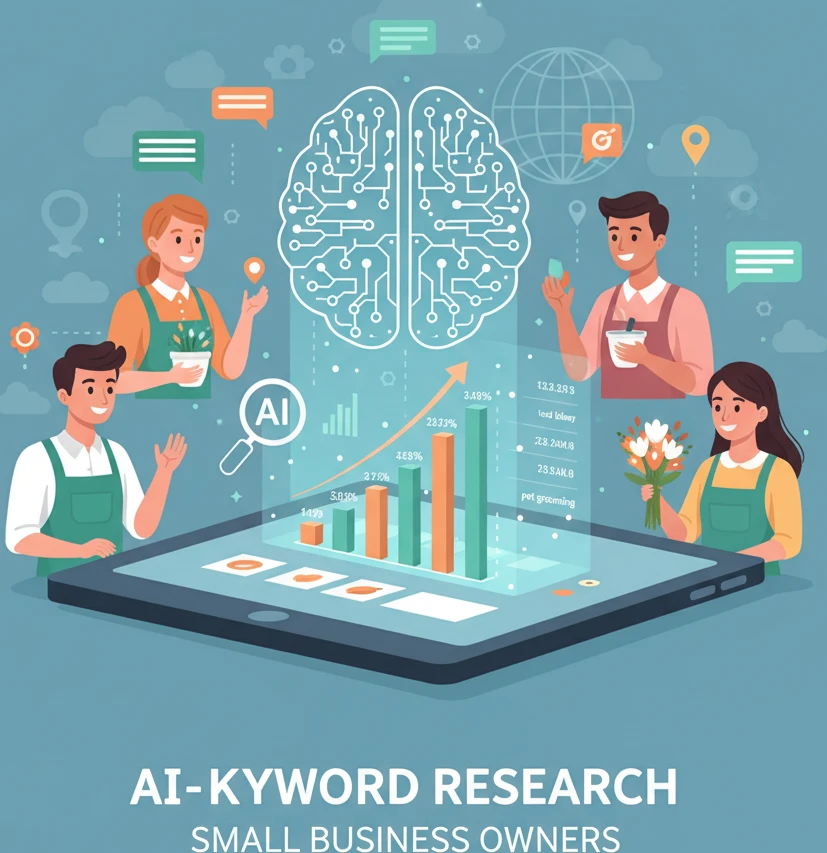
Understanding the AI-Powered Keyword Research Process: A Step-by-Step Guide
Defining Your Niche and Target Audience: The Foundation of Effective Research
Before diving into any AI tool, it’s crucial to have a clear understanding of your niche and target audience. Who are you trying to reach? What problems are you solving for them? What language do they use when searching for solutions? Creating detailed buyer personas can significantly improve the accuracy of your keyword research. The more specific you are, the better AI tools can understand your needs and generate relevant keyword suggestions. For instance, instead of simply saying “bakery,” define your niche as “vegan gluten-free bakery in downtown Austin.” This level of specificity will guide the AI to generate more targeted and effective keywords.
Choosing the Right AI Tools: Paid vs. Free Options for Small Businesses
The market is filled with AI-powered keyword research tools, ranging from free to premium options. Free tools like Google Keyword Planner offer basic keyword suggestions and search volume data. However, they often lack the advanced features and in-depth analysis provided by paid tools. Paid tools like Semrush, Ahrefs, and Surfer SEO offer a wider range of functionalities, including competitor analysis, long-tail keyword generation, and content optimization. Consider your budget and your specific needs when choosing a tool. A small business just starting might benefit from a free tool, while a more established business might find the investment in a premium tool worthwhile. Also consider free trials to test premium tools. Here’s a critical decision: are you focusing on SEO, Ads, Social Media or content creation, and what features in the AI tool match up to your marketing goals?
A Practical Example: Using AI to Find Keywords for a Local Bakery (KPI: Increasing Foot Traffic)
Let’s say you own a local bakery and your main KPI is increasing foot traffic. You start by defining your niche: “artisan sourdough bakery in San Francisco.” Using an AI tool, you input this phrase and ask it to generate related keywords. The AI might suggest keywords like “best sourdough bread San Francisco,” “artisan bakery near me,” “sourdough bread baking classes San Francisco,” and “unique bread flavors San Francisco.” You can then analyze the search volume and competition for each keyword to identify the most promising opportunities. Furthermore, the AI might suggest location-specific keywords like “bakery in North Beach” or “bakery on Columbus Avenue,” which can be highly effective for local SEO. By targeting these keywords in your website content, social media posts, and online advertising, you can attract more local customers to your bakery. If you’re using WordPress SEO, you can use those same keywords in the alt-text for your bakery images.
Selecting the Right AI Keyword Research Tool for Your Business Needs
Budget Considerations: Balancing Cost and Functionality
One of the first things small business owners need to consider is their budget. Many excellent AI-powered keyword research tools are available, but their pricing structures can vary greatly. It’s important to realistically assess your marketing budget and determine how much you can allocate to a keyword research tool. Some tools offer tiered pricing plans, allowing you to start with a basic plan and upgrade as your needs grow. Others offer one-time payment options or discounts for annual subscriptions. Remember to factor in the learning curve and the time it will take to master the tool. Don’t get lured into a tool with all the bells and whistles if you won’t use the features.
Ease of Use: Prioritizing User-Friendly Interfaces
Another crucial factor to consider is the ease of use of the AI keyword research tool. A complex or unintuitive interface can be a major barrier to adoption, especially for small business owners who may not have extensive technical expertise. Look for tools that offer a user-friendly interface, clear instructions, and helpful tutorials. Many tools offer free trials or demos, allowing you to test the interface before committing to a purchase. Consider the learning curve involved and whether the tool provides adequate support and documentation. Also consider your team’s existing skill set, and whether existing team members can adapt to the new tool’s workflow.
Specific Features: Identifying Tools That Align with Your Marketing Goals (Content Creation, Local SEO, etc.)
Different AI-powered keyword research tools offer different features and functionalities. Some tools specialize in content creation, providing suggestions for blog topics, article outlines, and even entire articles. Others focus on local SEO, helping you identify keywords that are relevant to your local area. Still others excel at competitor analysis, allowing you to see which keywords your competitors are targeting and how they are ranking. It’s important to choose a tool that aligns with your specific marketing goals. If you’re focused on local SEO, prioritize a tool with robust local keyword research capabilities. If you’re aiming to scale your content marketing efforts, look for a tool that offers content creation features. Consider if your business is in a specific niche and how the AI keyword research tool would align. Also, look into the available integrations with other digital marketing tools that you may be using.
Leveraging AI to Identify Long-Tail Keywords: The Secret to Niche Domination
What are Long-Tail Keywords and Why are They Important?
Long-tail keywords are longer, more specific phrases that people use when searching for information online. For example, instead of searching for “shoes,” someone might search for “best running shoes for flat feet under $100.” While long-tail keywords have lower search volumes than generic keywords, they are often less competitive and attract a more qualified audience. This means that people who use long-tail keywords are more likely to be further along in the buying process and are therefore more likely to convert. Long-tail keywords also provide valuable insights into customer needs and pain points, which can inform your overall marketing strategy.
AI-Powered Long-Tail Keyword Generation Techniques
AI tools can be incredibly effective at generating long-tail keyword suggestions. They can analyze search data, identify patterns in user behavior, and predict the types of questions people are asking online. Some AI tools can even analyze your existing content to identify opportunities to target long-tail keywords. For example, if you have a blog post about “dog training,” an AI tool might suggest long-tail keywords like “how to stop a dog from barking at night,” “best dog training treats for puppies,” or “positive reinforcement dog training methods.” By incorporating these keywords into your content, you can attract a more targeted audience and improve your search engine rankings. Additionally, AI-powered question analyzers can scrape forums and Q&A sites to find user questions related to your niche, which can then be used as long-tail keywords.
Example: Finding Hyper-Specific Keywords for a Dog Grooming Service
Let’s say you run a dog grooming service in a specific neighborhood. Instead of just targeting the keyword “dog grooming,” you can use an AI tool to find hyper-specific long-tail keywords like “affordable dog grooming near [Neighborhood Name],” “dog grooming for anxious dogs [Neighborhood Name],” “mobile dog grooming service for large breeds [Neighborhood Name],” or “organic shampoo dog grooming [Neighborhood Name].” These keywords are not only less competitive but also attract customers who are looking for very specific services. You could also target phrases like “dog nail trimming tips,” linking to blog content where you promote your nail trimming services. By targeting these hyper-specific keywords, you can attract a highly qualified audience and increase your chances of converting them into paying customers. This targeted approach is much more effective than simply trying to rank for generic keywords.
By understanding and leveraging the power of long-tail keywords, businesses can significantly improve their SEO performance, attract a more qualified audience, and drive more conversions.
Content Optimization for Long-Tail Keywords
Once you’ve identified your target long-tail keywords, the next step is to optimize your content to rank for those keywords. This involves several key strategies. First, make sure to naturally incorporate the keywords into your page titles, headings, and body text. Avoid keyword stuffing, which can hurt your rankings. Instead, focus on creating high-quality, informative content that answers the questions your target audience is asking. Use the keywords as a guide to create comprehensive and engaging content. Secondly, optimize your meta descriptions with relevant long-tail keywords to improve click-through rates from search results. Think of the meta description as an advertisement for your page; make it compelling and relevant to the user’s search query. Thirdly, build internal links using anchor text that includes your target long-tail keywords. This helps search engines understand the context of your content and improves its overall visibility. Finally, ensure that your website is mobile-friendly and loads quickly. Mobile-friendliness is a ranking factor, and page speed affects user experience and can impact your search engine rankings. For example, if targeting “best Italian restaurants with outdoor seating,” create a dedicated page featuring high-quality photos, customer reviews, and location information.
Measuring the Success of Long-Tail Keyword Strategies
Tracking the performance of your long-tail keyword strategy is essential for understanding its effectiveness and making data-driven decisions. Use tools like Google Analytics and Google Search Console to monitor your website’s traffic, keyword rankings, and conversion rates. Pay attention to which long-tail keywords are driving the most traffic and conversions. Analyze your website’s bounce rate and time on page for different long-tail keywords. A high bounce rate and low time on page may indicate that your content is not meeting the needs of your target audience. Continuously monitor your search engine rankings for your target long-tail keywords. Use rank tracking tools to track your progress and identify any areas where you need to improve. Ahrefs and SEMrush are popular tools for this purpose. Also, regularly review your content and make updates as needed. Keep your content fresh and relevant to ensure that it continues to attract and engage your target audience. For instance, setting up custom dashboards in Google Analytics to track specific long-tail keywords can provide at-a-glance insights into campaign performance. By carefully tracking and analyzing your results, you can refine your long-tail keyword strategy and achieve your desired outcomes.
Tools and Resources for Long-Tail Keyword Research
Several tools and resources can assist you in identifying and analyzing long-tail keywords. Google Keyword Planner is a free tool that provides keyword ideas and search volume data. It is an excellent starting point for brainstorming long-tail keyword variations. Ahrefs is a comprehensive SEO tool that offers advanced keyword research capabilities, including the ability to find long-tail keywords with low competition. SEMrush is another popular SEO tool that provides keyword research, competitive analysis, and rank tracking features. It helps you discover long-tail keywords and analyze your competitors’ strategies. AnswerThePublic is a tool that generates questions and phrases related to your target keyword. This is helpful for identifying long-tail keyword opportunities based on user intent. Also consider using Google Trends to identify trending topics and search queries. This can help you discover new long-tail keyword opportunities related to current events and popular trends. Utilize social media platforms to monitor conversations and identify questions your target audience is asking. Social listening can provide valuable insights into long-tail keyword opportunities. By leveraging these tools and resources, you can effectively research and identify long-tail keywords that align with your business goals.
Examples of Successful Long-Tail Keyword Campaigns
Many businesses have achieved significant success by implementing well-planned long-tail keyword campaigns. An e-commerce store selling running shoes may target “best running shoes for marathon training on asphalt” to attract customers looking for specific products. A local bakery might use “where to find gluten-free cupcakes near me” to target customers searching for local options. A travel blog could target “affordable family vacation packages in the Caribbean with kids” to attract families looking for budget-friendly travel options. A software company may target “how to integrate CRM with marketing automation platform” to attract businesses looking for specific software solutions. These examples demonstrate how long-tail keywords can drive targeted traffic and increase conversions. By understanding the specific needs and interests of your target audience, you can create content that resonates with them and drives meaningful results.
Common Mistakes to Avoid
While long-tail keyword strategies can be highly effective, it is essential to avoid common mistakes that can hinder your success. Neglecting keyword research can lead to targeting irrelevant or ineffective long-tail keywords. Always conduct thorough research to identify keywords that align with your business goals and target audience. Creating low-quality or thin content can negatively impact your search engine rankings. Ensure that your content is informative, engaging, and provides value to your target audience. Overusing keywords or engaging in keyword stuffing can harm your search engine rankings. Use keywords naturally and focus on creating high-quality content. Ignoring mobile optimization can negatively impact your search engine rankings and user experience. Ensure that your website is mobile-friendly and provides a seamless experience for mobile users. Failing to track and analyze your results can prevent you from identifying areas for improvement. Continuously monitor your website’s traffic, keyword rankings, and conversion rates to refine your strategy. By avoiding these common mistakes, you can maximize the effectiveness of your long-tail keyword strategy.
Analyzing Keyword Intent with AI: Understanding What Your Customers Really Want
The Importance of Search Intent: Informational, Navigational, Transactional, Commercial
Understanding search intent is paramount for effective SEO strategy. Instead of just guessing what people are searching for, we need to understand *why* they are searching. Search intent typically falls into four categories: informational (seeking knowledge), navigational (looking for a specific website), transactional (intending to make a purchase), and commercial (researching before a purchase). For instance, someone searching “best digital marketing courses” has commercial intent, while “what is digital marketing” indicates informational intent. Recognizing these nuances allows you to tailor your content to meet user needs, leading to higher engagement and improved rankings. Consider a local bakery. Someone searching “bakery near me” has navigational intent and will respond well to a Google Maps listing and directions. But “how to bake sourdough” is informational, requiring a recipe or blog post.
Using AI to Classify Keyword Intent
AI provides tools to classify search intent at scale. Traditional methods involved manually analyzing keywords and guessing user intent, which was time-consuming and often inaccurate. AI algorithms, however, can analyze vast amounts of search data, SERP features, and user behavior patterns to automatically classify keyword intent. These tools use natural language processing (NLP) to understand the context of the search query and identify the underlying need. For example, AI can quickly identify that keywords including modifiers like “buy,” “price,” or “discount” usually indicate transactional intent. Some AI-powered prompt engineering tools can even analyze the content that currently ranks for a specific keyword to determine the dominant search intent. The decision to use a particular AI tool should be based on the tool’s accuracy (ideally validated against manual analysis), the size of your keyword list, and the integration capabilities with your existing SEO workflow.
Tailoring Content to Match Different Search Intents
Once you have classified keyword intent using AI, the next step is to tailor your content accordingly. For informational intent, focus on creating comprehensive, high-quality blog posts or guides that answer the user’s questions. For navigational intent, ensure your website is easily findable on search engines and that your contact information is readily available. For transactional intent, optimize your product pages with clear calls to action, high-quality images, and detailed product descriptions. And for commercial intent, create comparison guides, reviews, and case studies that help users make informed decisions. Returning to the bakery example, for the “bakery near me” search, ensure your Google Business Profile is complete and accurate, with updated hours and photos. For “how to bake sourdough,” create a detailed blog post or video tutorial. The success of your content hinges on accurately matching the content type, format, and depth to the identified search intent. Remember to continually monitor your content’s performance and adjust based on user engagement metrics.
Competitor Keyword Analysis with AI: Spying on Your Rivals (Ethically!)
Identifying Your Top Competitors Online
Before diving into keyword analysis, you need to identify your top online competitors. These are not necessarily the biggest companies in your industry, but rather the websites that consistently rank for the same keywords you are targeting. Start by manually searching for your target keywords and noting the websites that appear in the top search results. Then, use AI-powered SEO tools like Semrush or Ahrefs to identify other websites that rank for similar keywords. These tools can provide a comprehensive list of your competitors based on keyword overlap, traffic volume, and other relevant metrics. For a local business like a digital marketing training institute like KPIDM, your competitors might include other local training centers, online course platforms, and even individual consultants offering similar services. The key decision criteria here is relevance; focus on competitors targeting the same geographic area and offering comparable services.
Using AI to Uncover Their Keyword Strategies
Once you have identified your competitors, use AI to uncover their keyword strategies. AI-powered SEO tools can analyze your competitors’ websites to identify the keywords they are targeting, the content they are creating, and the backlinks they are building. This information can provide valuable insights into their overall SEO strategy and help you identify opportunities to improve your own. Some tools can even estimate the traffic volume generated by each keyword, allowing you to prioritize your efforts. Analyze the keywords that drive the most traffic to your competitors’ websites and identify any patterns or trends. Are they focusing on long-tail keywords? Are they targeting specific geographic areas? Are they creating content around specific topics? Consider analyzing their content marketing strategy as well by looking at blog topics and content formats.
Finding Gaps in Their Strategy and Capitalizing on Them
The ultimate goal of competitor keyword analysis is to identify gaps in their strategy and capitalize on them. Are there any keywords that your competitors are not targeting? Are there any content topics that they are neglecting? Are there any geographic areas where they are underperforming? Use AI to identify these gaps and develop a strategy to fill them. For example, if your competitors are not targeting long-tail keywords, create content that answers specific user questions. If they are neglecting a particular geographic area, optimize your website and content for that location. And if they are not creating content around a specific topic, create a comprehensive guide or blog series that covers the topic in detail. KPIDM could analyze competitors and find they aren’t focusing on AI-specific digital marketing training for business owners. This is a significant gap to capitalize on.
Content Optimization: Integrating AI-Driven Keywords into Your Website
On-Page Optimization: Title Tags, Meta Descriptions, and Header Tags
After you’ve identified relevant keywords using AI, the next crucial step is integrating them strategically into your website’s on-page elements. This includes title tags, meta descriptions, header tags (H1, H2, etc.), and image alt text. The title tag is a major ranking factor, so make sure to include your primary keyword naturally at the beginning if possible. Meta descriptions don’t directly impact rankings, but they influence click-through rates. Craft compelling descriptions that accurately summarize the page content and entice users to click. Header tags should be used to structure your content logically and highlight important keywords. For example, if you are writing a blog post about “AI-powered keyword research,” you might use H1 for the title, H2 for subheadings like “Benefits of AI Keyword Research,” and H3 for more specific points within each section. Remember, keyword stuffing is a big no-no, so aim for a natural and conversational tone.
Creating High-Quality Content Around Target Keywords
While keyword integration is important, it’s equally important to create high-quality, engaging content that provides value to your audience. Content quality is paramount for SEO success, and Google’s algorithms are increasingly sophisticated at identifying and rewarding websites that offer a great user experience. Focus on creating content that is informative, well-written, and optimized for readability. Use visuals, such as images and videos, to break up the text and keep readers engaged. Address the search intent behind your target keywords by providing comprehensive and relevant answers to user queries. Don’t just rehash existing content; strive to offer unique insights and perspectives. For example, instead of just listing the benefits of AI keyword research, share real-world examples of how KPIDM has used AI to improve its clients’ SEO performance.
Internal Linking Strategies for Improved SEO
Internal linking is a powerful SEO tactic that helps search engines understand the structure and hierarchy of your website. By linking related pages together, you can improve crawlability, distribute link equity, and guide users to relevant content. When creating internal links, use descriptive anchor text that accurately reflects the content of the linked page. Avoid using generic anchor text like “click here” or “learn more.” For example, if you are writing a blog post about “AI-powered keyword research,” you might link to a related page about “AI-powered content SEO tips” using the anchor text “AI content SEO tips.” Create a strategic internal linking plan that connects your most important pages and helps users navigate your website easily.
Avoiding Common Pitfalls: Ethical Considerations and Best Practices for AI-Powered Keyword Research
Keyword Stuffing: Why It’s Still a Bad Idea (Even with AI)
Although AI can help you find and analyze keywords more efficiently, it’s crucial to avoid the temptation of keyword stuffing. This outdated practice involves excessively repeating keywords in your content in an attempt to manipulate search engine rankings. However, Google’s algorithms are now sophisticated enough to detect keyword stuffing and penalize websites that engage in this practice. Keyword stuffing not only harms your SEO but also degrades the user experience, making your content difficult to read and understand. Instead of stuffing keywords, focus on using them naturally and sparingly within your content. Aim for a conversational tone and prioritize providing value to your audience. Remember, the goal is to write for humans, not search engines.
Generating High-Quality, Original Content
One of the biggest challenges with AI-powered content generation is ensuring that the output is high-quality and original. While AI can be a valuable tool for brainstorming ideas and generating drafts, it’s essential to avoid simply publishing AI-generated content without human oversight. Search engines prioritize original content, and duplicate or low-quality content can harm your SEO. Use AI as a starting point, but always edit and refine the content to ensure that it is accurate, engaging, and relevant to your audience. Add your own unique insights and perspectives to make the content truly valuable. Consider checking the content with a plagiarism tool to ensure uniqueness.
Staying Up-to-Date with Google’s Algorithm Updates
The SEO landscape is constantly evolving, and Google’s algorithms are regularly updated to improve search results. To stay ahead of the curve, it’s essential to stay up-to-date with the latest Google algorithm updates and adjust your SEO strategy accordingly. Follow industry blogs, attend webinars, and participate in online forums to learn about the latest trends and best practices. Pay attention to Google’s official announcements and guidelines. Be prepared to adapt your strategy as needed to ensure that your website continues to rank well in search results. Remember, SEO is an ongoing process, not a one-time fix.
Measuring Your Success: Tracking Keyword Rankings and Website Traffic
Setting Realistic SEO Goals
Before diving into analytics, it’s crucial to define what “success” looks like for your small business. Realistic SEO goals should be Specific, Measurable, Achievable, Relevant, and Time-bound (SMART). Avoid vague aspirations like “rank higher.” Instead, aim for something like “Increase organic traffic from ‘best AI tool for keyword research’ by 20% in six months.” Consider your current website traffic, conversion rates, and overall business objectives. If you are starting from scratch, acquiring top-three rankings for competitive head terms might be unrealistic, while focusing on long-tail keywords relevant to your niche, or improving rankings for existing keywords, may be more attainable. Understand your business’s SEO maturity level and set goals that challenge you without being demoralizing. Don’t chase vanity metrics, either. Focus on keywords that drive qualified leads and sales.
Using Analytics Tools to Monitor Progress
Once you have defined your goals, it’s time to implement tools that can track your progress. Google Analytics 4 (GA4) is a foundational tool for any website, offering insights into website traffic, user behavior, and conversions. Pay attention to organic traffic sources to see how your keyword strategy is performing. Google Search Console provides data on your website’s search performance, including keyword rankings, click-through rates (CTR), and indexing status. In addition to these free tools, consider leveraging AI-powered SEO platforms that offer more in-depth keyword tracking and competitor analysis. These tools often provide features like rank tracking, backlink analysis, and content optimization suggestions. However, remember that no single tool is perfect, and relying on multiple sources of data can provide a more complete picture of your SEO performance. Be sure to properly configure conversion tracking within GA4 to measure the impact of your SEO efforts on your bottom line.
Adjusting Your Strategy Based on Performance Data
SEO isn’t a “set it and forget it” activity. Regularly monitor your analytics data and make adjustments to your strategy as needed. If a keyword isn’t performing as expected, consider revising your content or targeting a different keyword phrase. Look for trends and patterns in your data. Are certain types of content performing better than others? Are there specific keywords that are driving more conversions? Use these insights to inform your content creation and optimization efforts. Don’t be afraid to experiment with different approaches and A/B test different elements of your website. Remember, SEO is an ongoing process of learning and refinement. Be prepared to adapt to changes in search engine algorithms and user behavior. Keep a close eye on your competitors’ strategies as well. What keywords are they targeting? What types of content are they creating? Use this information to identify opportunities for improvement and stay ahead of the curve.
Future-Proofing Your SEO Strategy: Adapting to the Evolving AI Landscape
The Ongoing Development of AI in SEO
The field of SEO is constantly changing, and AI’s integration is accelerating this change. Search engines are becoming more sophisticated in their ability to understand user intent and deliver relevant search results. This means that traditional SEO techniques like keyword stuffing are becoming less effective. Focusing on creating high-quality, engaging content that provides value to your audience is more important than ever. As AI continues to develop, it will likely play an even bigger role in search engine algorithms, so it’s crucial to stay informed about the latest developments and adapt your strategy accordingly. Learn how AI tools assist with keyword selection to stay ahead. Understand your target audience and how they are using search, so that you can provide valuable resources.
Staying Informed About New Tools and Techniques
To future-proof your SEO strategy, it’s essential to stay up-to-date on the latest AI tools and techniques. Read industry blogs, attend webinars, and follow thought leaders on social media to stay informed. Experiment with new tools and techniques to see what works best for your business. For example, explore how prompt engineering is vital when interacting with AI tools. Be aware that not all tools are created equal, and some may be more effective than others. Before investing in a tool, do your research and read reviews from other users. Don’t be afraid to ask for help from other SEO professionals or consultants. There are many online communities where you can connect with other marketers and learn from their experiences. Keep an open mind and be willing to adapt your strategy as new technologies and techniques emerge. Remember that the key to success is to focus on providing value to your audience and creating a positive user experience.
Focusing on Long-Term, Sustainable Growth
While AI can help you automate and optimize certain aspects of your SEO, it’s important to remember that it’s not a magic bullet. The most effective SEO strategies are built on a foundation of high-quality content, strong technical SEO, and a focus on user experience. Don’t focus solely on short-term gains. Instead, focus on building a sustainable SEO strategy that will drive long-term growth for your business. This means investing in content creation, link building, and website optimization. It also means staying true to your brand values and providing a positive experience for your audience. For instance, making your WordPress website SEO-friendly is a long-term tactic that pays off. By focusing on these core principles, you can future-proof your SEO strategy and ensure that your business continues to thrive in the years to come.
Case Study: A Local Business Success Story Powered by AI Keyword Research
Brief Background of the Business
Let’s consider “The Coffee Nook,” a small, independently owned coffee shop in Austin, Texas. The Coffee Nook struggled to attract new customers amidst stiff competition from larger coffee chains and other local cafes. They had a basic website but minimal SEO presence, relying primarily on word-of-mouth and local flyers. Their online visibility was almost nonexistent, and they were missing out on potential customers searching for “best coffee in Austin” or “local coffee shop near me.” The owner, Sarah, recognized the need to improve their online presence but lacked the time and expertise to dedicate to a full-blown SEO campaign. She knew that using AI tools could help.
The AI Keyword Research Strategy Implemented
Sarah decided to explore AI-powered keyword research tools to identify relevant and high-potential keywords for her business. She used a tool that analyzed search volume, competition, and keyword intent to identify a list of target keywords. The tool suggested focusing on long-tail keywords like “best iced latte near Zilker Park” and “gluten-free pastries Austin coffee shop,” as these had lower competition and were highly relevant to her offerings. Sarah used these keywords to optimize her website content, including her homepage, menu pages, and blog posts. She also started creating content around these keywords, such as blog posts about “The Best Gluten-Free Treats to Pair with Your Coffee” and “Exploring Zilker Park? Grab an Iced Latte at The Coffee Nook.” Local SEO optimization, a strong area where AI helps, became a key focus.
Results and Key Takeaways
Within three months, The Coffee Nook saw a significant increase in organic traffic to its website. Their ranking for “best iced latte near Zilker Park” jumped from page three to the top three positions. Website traffic from local searches increased by 40%, and online orders through their website increased by 25%. More importantly, Sarah noted a noticeable increase in new customers visiting her coffee shop, mentioning they found her online. The key takeaway here is that AI-powered keyword research, even at a basic level, can have a significant impact on a small business’s online visibility and revenue. By focusing on relevant long-tail keywords and creating valuable content, Sarah was able to attract new customers and compete effectively with larger businesses in her area.
Your Next Steps: Embracing AI for Keyword Research to Grow Your Small Business
Choosing Your First AI Tool and Getting Started
There are numerous AI-driven SEO tools available, catering to different needs and budgets. Start by identifying your specific requirements. Do you need help with keyword research, content optimization, rank tracking, or competitive analysis? Free trials are your friend. Many tools offer free trials or basic versions that allow you to experiment with their features before committing to a paid plan. Consider tools that offer a user-friendly interface and comprehensive support resources. Prioritize those that integrate seamlessly with your existing workflows and analytics platforms. Some tools provide initial prompt guidance to use the specific tool at its best, so remember to start with that step.
Setting Aside Time for Experimentation and Learning
AI-driven SEO is an iterative process. You will need to dedicate time to experiment with different strategies, analyze your results, and make adjustments as needed. Don’t expect overnight success. SEO takes time and effort, and it’s essential to be patient and persistent. Set aside dedicated time each week to work on your SEO efforts. This could involve keyword research, content creation, website optimization, or link building. Track your progress and celebrate your successes along the way. Remember that learning is ongoing. Continuously seek out new information and techniques to improve your skills. With consistent effort and a willingness to learn, you can unlock the power of AI to grow your small business.
Join the KPIDM Community for Support and Guidance
Navigating the complexities of AI-powered SEO can be challenging, especially for small business owners. You don’t have to do it alone. The KPIDM community offers a supportive environment where you can connect with other business owners, ask questions, share your experiences, and