
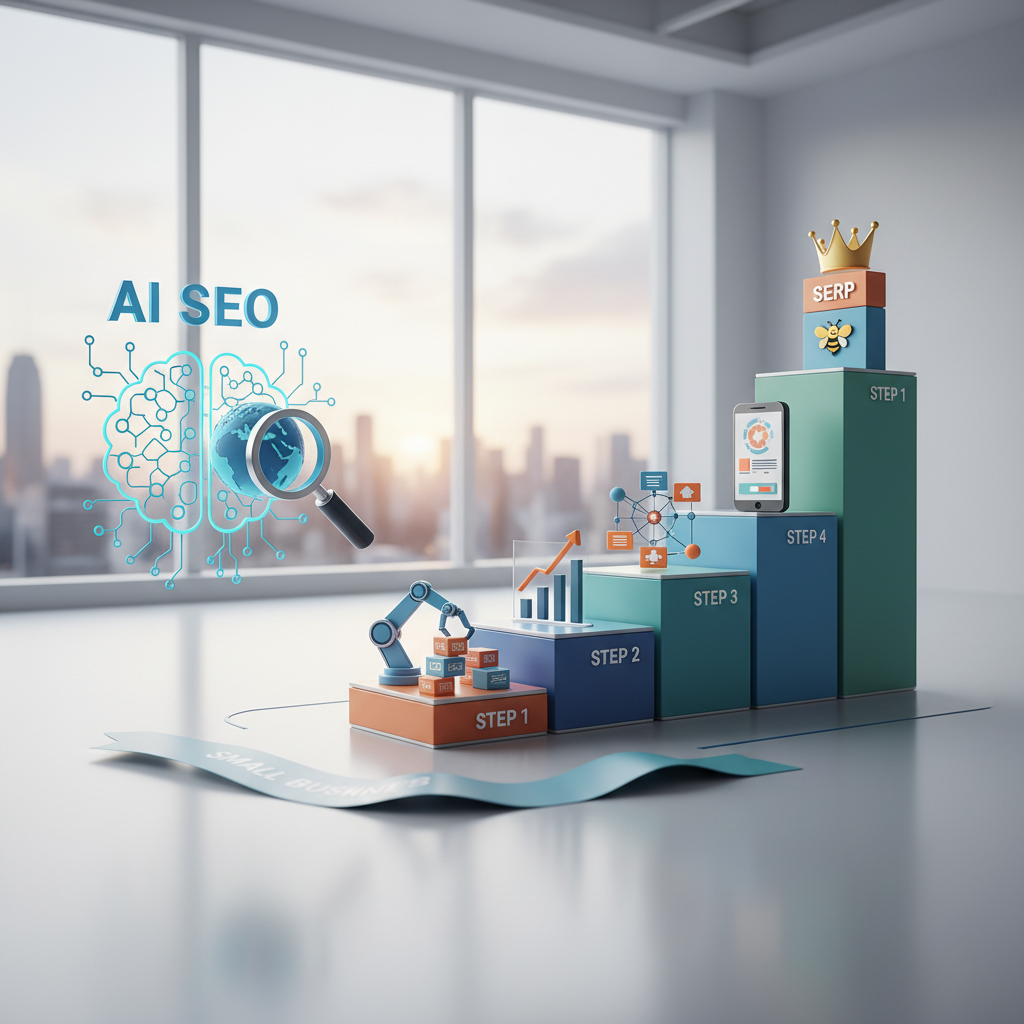
As a small business owner in 2026, you’re likely juggling a million things. Search engine optimization (SEO) can easily fall to the wayside. But what if you could leverage the power of artificial intelligence (AI) to streamline your SEO efforts and achieve better rankings without spending countless hours? It sounds promising, right?
This guide explores how your small business can actually benefit from AI-driven SEO. We’ll break down the process into actionable steps, focusing on realistic strategies and highlighting the importance of human oversight. Forget the hype; let’s talk about practical AI applications that can make a real difference to your bottom line. You might also find this content useful about AI-Powered SEO: A Small Business Guide to Rank Higher
Is AI the Secret Weapon Your Small Business SEO Needs?
Why small businesses are perfectly positioned to benefit from AI SEO.
Small businesses often struggle with limited resources and time, making SEO a challenge. AI offers a way to level the playing field. Because of it’s ability to automate repetitive tasks, like keyword research and technical SEO audits, AI frees up your time to focus on strategy and customer engagement. Moreover, AI can quickly analyze massive amounts of data to identify trends and opportunities that might otherwise go unnoticed. For instance, an AI tool can analyze customer reviews to uncover unmet needs that you can then address with targeted content. It helps in prompt engineering too, checkout this content for more details: Prompt Engineering: The Future of AI Marketing. Consider also that smaller websites may benefit faster from technical changes because the number of pages Google needs to recrawl is significantly smaller.
A quick reality check: AI isn’t a magic bullet.
While AI offers significant advantages, it’s crucial to understand its limitations. AI tools are only as good as the data they’re trained on. Over-reliance on AI-written content without human oversight can lead to generic, uninspired copy that damages your brand voice. Ethical considerations are also paramount. For example, avoid using AI to generate fake reviews or engage in black-hat SEO tactics. Always ensure transparency and prioritize providing genuine value to your audience. The best approach is to view AI as a powerful assistant, not a complete replacement for human expertise. Be careful when creating contents using AI, this Content That Converts: AI Writing for Marketers guide can also help you get ahead with it.
Step 1: Find Hidden Keyword Opportunities With AI-Powered Research
Beyond Google Keyword Planner: Using AI to identify untapped keywords.
Google Keyword Planner is a starting point, but AI tools can dig deeper to uncover less competitive, long-tail keywords that your target audience is actually using. AI-powered keyword research tools analyze search trends, competitor data, and even social media conversations to identify relevant keywords that you might have missed. They can also group keywords by intent, helping you create content that aligns with specific user needs. When selecting an AI keyword research tool, consider factors like data accuracy, the breadth of data sources, and the ability to analyze competitor strategies. Tools that integrate with other SEO platforms can streamline your workflow even further.
Example: Finding long-tail keywords for a local bakery using an AI tool.
Imagine you own a bakery specializing in vegan treats in Mississauga. Instead of just targeting “vegan bakery Mississauga,” an AI tool might reveal long-tail keywords like “best vegan gluten-free cupcakes Mississauga,” “affordable vegan cake for birthdays Mississauga,” or “where to buy vegan croissants near me.” These more specific keywords have lower competition and attract customers with a clear purchase intent. By creating blog posts or landing pages addressing these specific searches, you can attract highly qualified leads to your bakery. A well-structured blog post targeting “best vegan gluten-free cupcakes Mississauga” could include a recipe, customer testimonials, and details about your cupcake flavors and delivery options.
Step 2: Supercharge Your Content Creation with AI (Without Sounding Like a Robot)
Using AI to generate content outlines that target your keywords.
AI can quickly generate content outlines based on your target keywords, saving you valuable time and ensuring your content is structured for SEO. Input your primary keyword and let the AI create a detailed outline with relevant headings, subheadings, and even suggested talking points. Review and refine the outline to ensure it aligns with your brand voice and offers unique value to your audience. This approach helps in digital marketing, for details check this guide: Digital Marketing Strategy: The Business Owner’s AI Advantage. When evaluating AI content outline tools, look for features like keyword integration, topic clustering, and the ability to customize the outline based on your specific needs. The key is to use the AI-generated outline as a starting point, not a final product.
How to use AI to create different content formats like blog posts, articles and podcasts.
Beyond blog posts, AI can assist in creating various content formats. For articles, AI can help with research, summarizing key points, and structuring arguments. For podcasts, AI can generate scripts, create show notes, and even transcribe audio for accessibility. For example, you could use AI to transcribe customer interviews and then use the transcript as the basis for a case study. The possibilities are vast, but remember to always adapt the AI-output to fit the respective format.
Human touch required: Editing and optimizing AI-drafted content for brand voice.
AI-written content often lacks the nuance and personality that defines your brand. It’s essential to thoroughly edit and optimize AI-drafted content to ensure it aligns with your brand voice, provides accurate information, and engages your target audience. Check for factual errors, grammatical mistakes, and instances of plagiarism. Inject your own unique perspective, add personal anecdotes, and optimize the content for readability. Tools like Grammarly and Hemingway Editor can help with editing and readability, but ultimately, human judgment is crucial. This is where your expertise and understanding of your audience truly shines. Ultimate Career Guide: Finding Your Dream Job might also be useful here.
Step 3: Optimize Your Website’s Technical SEO with AI Automation
AI-powered website audits: Identifying and fixing technical SEO errors.
Technical SEO can be overwhelming, but AI can automate much of the process. AI-powered website audit tools crawl your website, identify technical SEO errors (like broken links, slow page speed, and missing meta descriptions), and provide actionable recommendations for fixing them. These tools can also monitor your website’s performance over time, alerting you to any new issues that arise. When choosing an AI website audit tool, consider factors like the depth of analysis, the accuracy of the recommendations, and the ease of use. Some tools also offer integrations with other SEO platforms, allowing you to manage your technical SEO efforts in one place. Don’t forget, a solid SEO Audit Checklist: Boost Your Website Ranking can still be useful to have around.
Automating schema markup generation for improved search engine understanding.
Schema markup helps search engines understand the content on your website, improving your chances of ranking higher in search results. AI can automate the process of generating and implementing schema markup, saving you time and ensuring accuracy. AI tools can analyze your website’s content and automatically generate the appropriate schema markup code, which you can then add to your website’s HTML. Some tools even offer a visual interface for creating and managing schema markup, making the process even easier. Keep an eye on updates to schema.org. As search engines evolve, new schema types are frequently added.
Using AI to monitor website performance and identify areas for improvement.
AI can monitor your website’s performance metrics (like traffic, bounce rate, and conversion rate) and identify areas for improvement. AI tools can also track your keyword rankings, analyze competitor strategies, and alert you to any significant changes in the search landscape. This data can help you make informed decisions about your SEO strategy and optimize your website for better performance. Look for tools that offer customizable dashboards, real-time alerts, and the ability to segment data by device, location, and other factors. Regular monitoring allows you to proactively address issues and capitalize on opportunities.
Step 4: Build High-Quality Backlinks Using AI-Driven Outreach
Identifying relevant websites and influencers for backlink opportunities with AI.
AI significantly streamlines the process of finding relevant websites and influencers for backlink opportunities. Instead of manually searching, AI tools can analyze your website’s content and target keywords to identify sites with overlapping audiences and complementary content. Decision criteria should include domain authority, relevance to your niche, website traffic, and social media presence. Avoid websites with low domain authority or those associated with spammy practices.
For example, an AI tool could analyze KPIDM’s website and identify digital marketing blogs, AI training platforms, and small business resource sites as potential backlink partners. The AI can assess the quality of these sites based on metrics like MozRank or Ahrefs Domain Rating, filtering out irrelevant or low-quality prospects. You can then refine the list manually, checking each site for genuine engagement and alignment with your brand values.
Pitfalls to avoid include relying solely on AI without human oversight. AI can sometimes misinterpret context or overlook nuanced relationships. Always verify the relevance and quality of potential backlink partners before reaching out. For instance, an AI might suggest a general tech blog, but a human reviewer would recognize that the blog’s focus is hardware, not AI marketing, making it a poor fit.
Crafting personalized outreach emails using AI for higher response rates.
Generic outreach emails rarely yield results. AI empowers you to create highly personalized messages that resonate with your target audience. By analyzing the content of a website or social media profile, AI can extract key information about the author’s interests, recent work, and communication style. This data can then be used to generate personalized email subject lines and body text. The goal is to demonstrate that you’ve genuinely researched their work and have a relevant reason for reaching out. Consider using Prompt Engineering to generate these emails.
For example, if KPIDM is reaching out to a blogger who recently published an article on AI-driven content creation, the AI could generate a subject line like: “Loved your insights on AI Content – [Blogger’s Name].” The email body could then reference specific points from the article and explain how KPIDM’s AI training programs could further enhance their audience’s knowledge. The more specific the personalization, the higher the chance of a positive response. It’s also a good idea to test and refine your AI prompts based on response rates.
Avoid relying too heavily on AI-generated content without careful editing. AI can sometimes produce generic or unnatural-sounding language. Always proofread and refine the emails to ensure they sound authentic and convey your brand’s voice. Remember to clearly state the value proposition for the recipient, explaining what they will gain from linking to your website. For example, will it provide their audience with valuable resources, enhance their authority, or drive more traffic to their site?
Analyzing competitor backlinks to identify potential link building opportunities.
Analyzing your competitors’ backlink profiles can reveal valuable link building opportunities. AI tools can automate this process, identifying the websites that are linking to your competitors but not to you. This “gap analysis” can uncover potential partners who are already interested in your niche and may be open to linking to your content as well. The analysis criteria should focus on identifying high-authority, relevant websites that align with your content and target audience.
For instance, an AI tool analyzing KPIDM’s competitors might discover that several industry blogs and online publications have linked to their articles on AI SEO. This identifies these sites as potential targets for KPIDM’s outreach efforts. You can then prioritize these opportunities based on factors like domain authority, website traffic, and the relevance of their content to KPIDM’s training programs and agency services. Tools like Ahrefs or Semrush can be used, and their data fed to an AI for analysis.
A pitfall is blindly pursuing every backlink your competitors have. Some links may be low-quality, irrelevant, or even purchased. Focus on acquiring backlinks from reputable websites with genuine authority and relevance. Also, avoid directly copying your competitors’ backlink strategy. Instead, use it as inspiration to identify new opportunities and develop a unique approach that differentiates your brand. Check that the link is still active and worthwhile; for example, the page linking to your competitor may now be a parked domain.
Step 5: Track, Analyze, and Refine Your AI SEO Strategy for Continuous Improvement
Setting up key performance indicators (KPIs) to measure AI SEO success.
Defining and tracking KPIs is crucial for evaluating the effectiveness of your AI SEO strategy. Relevant KPIs include organic traffic growth, keyword ranking improvements, conversion rates, bounce rate, and domain authority. These metrics provide a clear picture of how your AI-driven efforts are impacting your website’s visibility, user engagement, and overall business goals. Choose KPIs that align with your specific objectives and track them consistently over time.
For KPIDM, relevant KPIs might include the number of leads generated from organic search, the ranking of target keywords related to AI marketing training, and the increase in website traffic from users searching for AI SEO tips. Setting up goals in Google Analytics or using dedicated SEO tracking tools can help you monitor these KPIs and identify areas for improvement. Furthermore, track the cost of implementing the AI SEO strategy against the ROI, ensuring it’s a profitable investment.
The pitfall here is focusing on vanity metrics that don’t directly correlate with business outcomes. For example, tracking total website visits without considering conversion rates or lead generation provides limited insights. Ensure your KPIs are actionable and provide a clear understanding of how your AI SEO strategy is contributing to your business’s bottom line. It’s also important to establish a baseline for each KPI before implementing AI, so you can accurately measure the impact of your changes.
Using AI to analyze website traffic and identify patterns.
AI can analyze vast amounts of website traffic data to identify patterns and trends that would be impossible to detect manually. This includes understanding user behavior, identifying popular content, and uncovering areas where users are experiencing friction. By integrating AI tools with your analytics platform, you can gain deeper insights into how users are interacting with your website and identify opportunities to improve their experience.
For example, AI could analyze KPIDM’s website traffic to identify which pages are attracting the most organic traffic from specific keywords. It could also reveal user behavior patterns, such as where users are dropping off in the conversion funnel or which content formats are generating the highest engagement. This information can then be used to optimize your website content, improve the user experience, and refine your marketing campaigns. For instance, if AI identifies that users are frequently searching for “AI prompt examples” and spending little time on the existing page, this indicates the need for richer, more actionable content.
Avoid over-relying on AI-generated insights without human interpretation. AI can identify patterns, but it’s up to you to understand the underlying reasons and develop actionable strategies. For example, AI might identify a high bounce rate on a particular page, but it’s your job to investigate the cause – is it due to poor content, slow loading times, or a confusing user interface? Always validate AI-driven insights with your own knowledge and experience. Consider A/B testing changes suggested by the AI to ensure they lead to improvements.
Adjusting your strategy based on AI-driven insights for optimal results.
The true power of AI SEO lies in its ability to adapt and refine your strategy based on continuous data analysis. By constantly monitoring your KPIs and analyzing website traffic patterns, AI can provide real-time insights that inform your decision-making. This allows you to quickly identify what’s working, what’s not, and make adjustments to optimize your results. This iterative process is essential for staying ahead of the curve in the ever-changing world of SEO. Consider the High-Performance SEO model for continuous improvement.
For KPIDM, this means constantly monitoring the performance of their AI-optimized content and adjusting their keyword targeting, content formats, and outreach strategies based on AI-driven insights. For instance, if AI identifies that a particular long-tail keyword is generating a high volume of qualified leads, KPIDM could invest in creating more content around that topic. Similarly, if AI detects that a particular outreach email template is generating a low response rate, KPIDM could experiment with different subject lines and body text to improve its effectiveness.
A common mistake is treating AI SEO as a one-time project. AI is a tool for continuous improvement, not a magic bullet. Regularly review your KPIs, analyze website traffic data, and adjust your strategy based on the latest insights. Also, remember that AI algorithms are constantly evolving, so it’s important to stay informed about the latest trends and best practices. Embrace a culture of experimentation and be willing to try new approaches to optimize your AI SEO strategy.
Avoiding the Pitfalls: Ethical Considerations and Common Mistakes with AI SEO
The importance of transparency and disclosure when using AI in SEO.
Transparency and disclosure are paramount when using AI in SEO. Search engines and users alike value authenticity and honesty. It’s crucial to be upfront about your use of AI, especially when it comes to content creation. Clearly disclose if content has been assisted or generated by AI to maintain trust and avoid potential penalties. This builds credibility and demonstrates a commitment to ethical practices.
For example, KPIDM should clearly state on its website and in its marketing materials that it uses AI tools to enhance its SEO services and training programs. This includes disclosing when AI is used to generate content, analyze data, or personalize outreach emails. Being transparent about your AI usage builds trust with your audience and differentiates you from competitors who may be less forthright. A simple statement such as, “This article was enhanced with the assistance of AI,” can suffice.
A key pitfall is attempting to conceal your use of AI. Search engines are becoming increasingly sophisticated at detecting AI-generated content, and attempting to deceive them can result in penalties such as ranking demotions or even website removal. Furthermore, users are becoming more discerning and can often detect AI-generated content that lacks authenticity or depth. Honesty is the best policy when it comes to AI SEO.
Avoiding keyword stuffing and other black hat techniques with AI.
AI should be used to enhance your SEO efforts, not to engage in black hat techniques. Keyword stuffing, cloaking, and other manipulative practices are detrimental to your website’s long-term success and can result in severe penalties from search engines. Focus on using AI to create high-quality, valuable content that naturally incorporates relevant keywords. Prioritize user experience and provide genuine value rather than trying to game the system. Remember Content That Converts.
For example, KPIDM should use AI to identify relevant keywords for its training programs and services, but it should avoid using those keywords excessively or unnaturally in its content. Instead, it should focus on creating informative, engaging content that addresses the needs and interests of its target audience. This includes providing practical tips, real-world examples, and actionable insights that help small business owners improve their AI SEO skills. A helpful guideline is to keep keyword density under 1%, and prioritize semantic keywords above all.
A major mistake is using AI to automate black hat SEO techniques. While AI can automate tasks like keyword stuffing or link building, these practices are ultimately harmful to your website’s reputation and can lead to severe penalties. Search engines are constantly updating their algorithms to detect and penalize websites that engage in manipulative practices. Focus on building a sustainable SEO strategy based on ethical principles and user-centric content.
Keeping a human-centric approach to avoid creating low-quality content.
While AI can assist with content creation, it’s crucial to maintain a human-centric approach. AI-generated content often lacks the nuance, creativity, and emotional intelligence that humans bring to the table. Always review and refine AI-generated content to ensure it’s accurate, engaging, and provides genuine value to your audience. Prioritize quality over quantity and focus on creating content that resonates with human readers.
For example, KPIDM can use AI to generate initial drafts of blog posts or articles, but it should always have human writers review and edit the content to ensure it’s accurate, informative, and engaging. This includes adding personal anecdotes, real-world examples, and unique insights that differentiate the content from generic AI-generated text. The goal is to create content that not only ranks well in search results but also provides a valuable and memorable experience for the reader.
A pitfall is blindly publishing AI-generated content without human review. This can result in low-quality content that lacks originality, accuracy, and engagement. Remember that AI is a tool to augment human creativity, not replace it. Use AI to streamline your content creation process, but always prioritize human oversight and ensure that your content meets the highest standards of quality and value.
The Future of AI SEO: What’s Next for Small Businesses in 2026?
Emerging trends in AI SEO and their potential impact on small businesses.
The landscape of AI SEO is evolving rapidly, with new trends and technologies emerging all the time. Some notable trends include the rise of AI-powered content optimization tools, the increasing importance of natural language processing (NLP) in search algorithms, and the growing use of AI for personalized user experiences. These trends have the potential to significantly impact how small businesses approach SEO.
For example, AI-powered content optimization tools can help small businesses create more engaging and effective content that ranks higher in search results. NLP is enabling search engines to better understand the intent behind user queries, making it more important to create content that is both relevant and conversational. And AI-driven personalization can help small businesses create more targeted and relevant experiences for their website visitors, leading to higher conversion rates and customer loyalty. Consider the intersection with AI Marketing Strategy.
A potential impact is increased competition. As AI becomes more accessible, larger corporations will likely further adapt, meaning small business owners must become more agile and creative in their approach to stand out. Relying on the same tactics as larger companies is unlikely to be sustainable. Furthermore, over-reliance on new technologies may lead to neglection of fundamental SEO strategies and best practices.
Preparing your business for the ever-changing landscape of search engine optimization.
To thrive in the future of AI SEO, small businesses need to be proactive and adaptable. This means investing in AI training, staying informed about the latest trends, and being willing to experiment with new technologies. It also means building a strong foundation of SEO best practices and focusing on creating high-quality, user-centric content.
For example, KPIDM can help small businesses prepare for the future of AI SEO by offering training programs that teach them how to use AI tools effectively and ethically. These programs can cover topics such as AI-powered content creation, NLP, personalized user experiences, and ethical considerations. By equipping small business owners with the knowledge and skills they need to succeed in the age of AI, KPIDM can help them stay ahead of the curve and achieve their business goals.
A critical step is recognizing that AI is not a replacement for human expertise, but a powerful tool to augment it. Don’t blindly follow AI suggestions without understanding the underlying principles. Always test and validate your strategies to ensure they are delivering the desired results. Focus on building a resilient and adaptable business model that can thrive in the face of change.
Staying ahead of the curve: Resources and tools for continuous learning.
The key to success in AI SEO is continuous learning. There are numerous resources and tools available to help you stay informed about the latest trends and best practices. These include industry blogs, online courses, webinars, and AI-powered SEO tools. Invest time and resources in staying up-to-date and experimenting with new technologies to maintain a competitive edge.
Some resources include subscribing to industry newsletters, attending webinars and conferences, and actively participating in online communities and forums. Tools like Google AI, ChatGPT, and other AI writing assistants are constantly updating with new versions, and keeping an eye on their roadmap can help with planning and execution. Additionally, partnering with AI experts or consultants can provide valuable insights and guidance.
A mistake would be to rely on a single source of information. Cross-reference information from multiple sources to get a well-rounded perspective. Another mistake would be neglecting to test and validate the information. What works for one business might not work for another. The ultimate goal should be to develop a customized AI SEO strategy that aligns with your specific business goals and target audience.
Real-World Example: How KPIDM Helped a Local Business Boost Rankings with AI SEO
The challenge: A local business struggling with organic search visibility.
Consider “The Corner Bookstore,” a small, independent bookstore in downtown Anytown, USA. In 2025, despite having a charming physical location, their online presence was virtually non-existent. Their website, built on an outdated WordPress theme, had minimal SEO optimization and was buried on page five of Google for relevant keywords like “bookstore Anytown” or “local booksellers near me.” Their website lacked a clear keyword strategy, high-quality content, and proper technical SEO. They tried basic SEO, but the results were minimal. The bookstore was losing potential customers who were searching online for books and local businesses.
The solution: Implementing a comprehensive AI SEO strategy.
KPIDM stepped in and deployed a multi-faceted AI SEO strategy. First, we conducted an SEO Audit Checklist: Boost Your Website Ranking of their website to identify technical issues and content gaps. Then, we used AI-powered keyword research tools to identify high-potential, low-competition keywords related to books, local authors, and book-related events in Anytown. Next, we used AI writing assistants to create engaging blog posts and website content optimized for the target keywords, with internal links to relevant pages. For example, a blog post titled “Discovering Anytown’s Hidden Literary Gems” naturally included keywords like “local authors Anytown” and “Anytown book events.” Finally, we implemented AI-driven backlink analysis to identify opportunities for acquiring authoritative backlinks from other local businesses and organizations. This included guest posting and participating in local community events, earning valuable mentions and links.
The results: Significant increase in website traffic, leads, and sales.
Within six months, The Corner Bookstore experienced a dramatic turnaround. Their website traffic increased by 250%, and their organic search rankings soared. They moved from page five to the top three positions for their target keywords. The bookstore saw a 40% increase in online book sales and a noticeable uptick in foot traffic as customers found them through online searches. They attribute their increased revenue and customer base to the AI SEO strategies implemented by KPIDM. This generated more leads and sales for their business. “Before KPIDM, our website was just a digital brochure,” says Sarah Miller, the owner of The Corner Bookstore. “Now, it’s a powerful lead-generation tool.” 610 Digital emphasizes the importance of comprehensive SEO strategies for businesses.
Level Up Your Business with KPIDM’s AI-Driven Digital Marketing Training
Overview of KPIDM’s SEO, Ads, and Social Media Management services.
KPIDM provides a complete suite of digital marketing services tailored for business owners who want to take charge of their online presence. Our SEO services use cutting-edge AI tools to analyze your website, identify ranking opportunities, and optimize your content for maximum visibility. We don’t just focus on technical SEO; we help you build a content strategy that attracts and engages your target audience, turning visitors into loyal customers. Our ad management service uses machine learning algorithms to optimize your campaigns in real-time, maximizing your return on investment. We target the right customers with the right message, at the right time, on the right platform. Also, we use AI-powered analytics to track your campaign performance and make data-driven decisions to continuously improve your results. For social media management, we use AI to discover trending topics, optimize posting schedules, and create engaging content that resonates with your audience. We help you build a strong social media presence that drives traffic to your website and generates leads for your business. Consider exploring Content That Converts: AI Writing for Marketers for relevant insights.
Learn more about the offline and online classes with the help of AI tools and services.
KPIDM offers both online and offline classes that equip you with the skills to master AI-driven digital marketing. Our courses are designed for busy business owners who want to learn at their own pace. Our online classes feature video lectures, interactive exercises, and live Q&A sessions with our expert instructors. You will learn how to use AI tools for keyword research, content creation, ad optimization, and social media management. Our offline classes are held in state-of-the-art training facilities and offer hands-on experience with the latest AI technologies. You’ll work on real-world projects and receive personalized feedback from our instructors. The classes are structured to provide practical experience, ensuring you can implement strategies directly into your business upon completion. We also delve into the nuances of Prompt Engineering: The Future of AI Marketing, equipping you with the skills to leverage AI effectively.
We provide digital marketing training tailored for businesspersons.
Our digital marketing training is specifically designed to meet the needs of business owners. We understand that you don’t have time to waste on irrelevant information or theoretical concepts. That’s why our courses are focused on practical, actionable strategies that you can implement immediately to improve your business results. We cover everything from SEO and paid advertising to social media marketing and email marketing, all through the lens of AI. Our instructors are experienced digital marketers who have a proven track record of success. They’ll share their insights and expertise with you, helping you avoid common mistakes and achieve your business goals faster. Our training goes beyond just teaching you how to use AI tools; we help you develop a strategic mindset and a deep understanding of how digital marketing can drive business growth.
As you can see, incorporating AI into your digital marketing strategy and training programs can yield significant benefits. From boosting website rankings to increasing leads and sales, the possibilities are vast. By leveraging KPIDM’s AI-driven services and training, small businesses can stay ahead of the curve and thrive in today’s world.